Background
Yesterday I completed seven days of writing online, officially marking me with 20 more to go. After finishing my first week of daily content creation I’ve gotten more comfortable with producing, made some connections, and am on the way to finding my path forward.
It’s important to take a moment to reflect in order to move forward with a mindset focused on improvement. Learning out loud is an essential key to success, but I have discovered that there’s an important balance that people don’t often talk about. It’s one thing to just get your stuff out there. But in order to learn and level up, self-reflection needs to be present.
Since I am making content every day, weekly reflection points are what work for me. And this week I have found one particular method of reflection that can stand the test of time.
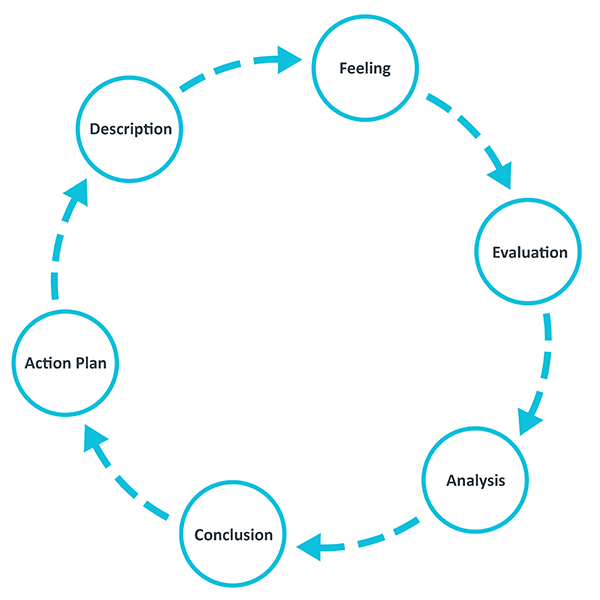
Gibbs Reflective Cycle. Developed by Graham Gibbs in 1988, was made to provide structure to learning experiences. Below, I will be sharing this information that I found on the University of Edinburgh’s website. Beginning with his six stages and then diving into more detail.
The 6 Stages of Gibb’s Reflective Cycle:
- Description of the experience
- Feelings and thoughts about the experience
- Evaluation of the experience, both good and bad
- Analysis of the situation
- Conclusion about what you learned and what you could have done differently
- Action plan for how you would deal with similar situations in the future, or general changes you might find appropriate.
Description
Describe the situation in detail. Your feelings and conclusions will come later.
Helpful questions:
- What happened?
- When and where did it happen?
- Who was present?
- What did you and the other people do?
- What was the outcome of the situation?
- Why were you there?
- What did you want to happen?
Feelings
Feelings or thoughts that you had during the experience and how they may have impacted the experience.
Helpful questions:
- What were you feeling during the situation?
- What were you feeling before and after the situation?
- What do you think other people were feeling about the situation?
- What do you think other people feel about the situation now?
- What were you thinking during the situation?
- What do you think about the situation now?
Evaluation
Evaluate what worked and what didn’t work in the situation. To get the most out of your reflection focus on both the positive and the negative aspects of the situation, even if it was primarily one or the other.
Helpful questions:
- What was good and bad about the experience?
- What went well?
- What didn’t go so well?
- What did you and other people contribute to the situation (positively or negatively)?
Analysis
Up until now you have focused on details around what happened in the situation. Now you have a chance to extract meaning from it. You want to target the different aspects that went well or poorly and ask yourself why.
Helpful questions:
- Why did things go well?
- Why didn’t it go well?
- What sense can I make of the situation?
- What knowledge – my own or others (for example academic literature) can help me understand the situation?
Conclusions
This is where you summarize your learning and highlight what changes to your actions could improve the outcome in the future. It should be a natural response to the previous sections.
Helpful questions:
- What did I learn from this situation?
- How could this have been a more positive situation for everyone involved?
- What skills do I need to develop for me to handle a situation like this better?
- What else could I have done?
Action plan
Plan for what you would do differently in a similar or related situation in the future. It can also be extremely helpful to think about how you will help yourself to act differently – such that you don’t only plan what you will do differently, but also how you will make sure it happens.
Helpful questions:
- If I had to do the same thing again, what would I do differently?
- How will I develop the required skills I need?
- How can I make sure that I can act differently next time?
Self Reflection Is a Necessary Part of Continued Growth
Next time you hit a milestone in your goals, no matter how small, take half an hour to set yourself up for continued success. Development is about rapidly failing, but never failing the same way twice. And with this, I continue to push the bounds of growth by celebrating wins and continuously moving the mile-marker.
Thank you,
Olivia
 ooliviacrowley.com
Leave a comment